Rehearsal Wrap-Up

October 9th, 2011

Just got done rehearsing for two hours with Anton and Julian, literally.

Really, it was more of a reading session, since I hadn’t distributed parts beforehand. And I wanted to get a rough idea of whether some pieces would work or not for the performances in January and February. Here’s what we went through:

  • Why? by Teppo Hauta-aho. This piece is dark and distraught. It will be good to work on it.
  •  The Secret of Tao – written for us back in 2007 and premiered at MusiCircus. Thinking about reviving this rather demanding and quite contemporary piece. Written by Ilya Levinson.
  • Three Spanish Motets by Tomas Luis de Victoria, arranged by Michael Cameron. Very pleasant texture and sonority, these great motets–including O magnum mysterium–could be a very nice contrast to some of the more rough and tumble stuff. Is it some sort of musical blasphemy to describe masterworks of the renaissance era “pleasant?”
  • A Night in Compostela by Simón García – a nice piece, this will be a real crowd-pleaser. Maybe even best as an encore. However, I also think there might be a mystic element to bring out once we’re more familiar with it. This is only the first time I’ve played through it, after four-tracking just a few sections on my own.
  • Ultra-Rondo by Armand Russell – Honestly I bought this piece on the strength of my enjoyment of Russell’s Chaconne for double bass and piano. I’m not disappointed; however, this piece has more dark and challenging stuff than I expected. That’s a good thing.
  • Jan Alm‘s Kvartett för 4 kontrabasar – I love this quartet, it’s light and fun. I think it will be well-enjoyed.
I like to think that I have some interesting ideas to design the flow of a concert. I’ll continue to write about them, because I really want to be invited to speak at the cusp conference “The Design of Everything,” although I’m far from the most qualified person to speak on this subject 🙂
Rehearsals Begin for January and February

October 8th, 2011

Honestly, it is hard to overcome inertia, but I’m about to do so.

Honestly, the Chicago Bass Ensemble has been static, motionless, inert for several months. Things kind of decayed at the beginning of this year, and I didn’t do a good job of breaking through the stasis. I did get a lot of music for the group to play, when I was at the International Society of Bassists convention. And I was really pleased to hear from Ken Whitney during the summer to set up a performance at the First Presbyterian Church of Arlington Heights.

Now, I’m finally geared up to get going again. Tomorrow morning, Julian, Anton and I are getting together to go over repertoire for both our January and February performances. I’m excited!

So now I’m going to try something. One of my goals for this blog has been to shine a light onto the process of getting a performing group going. I mean to make regular entries. I haven’t been doing that, but I’m going to try again. For this week, here is my done well/needs improvement list:

Done Well

  • Pulled together a rehearsal (for tomorrow).
  • Made an entry on the Chicago Classical Music site.
  • Wrote this blog entry.
  • Left a message for my friend Wilson Hogan, with whom I am podcasting about Chicago Bass Ensemble.

Needs Improvement/To do

  • Get Wilson and me off our butts and record something for a podcast!
  • Confirm a fourth player for both the January and February events.
  • Get music from Mike Wittgraf for his piece which we’ll premiere in February.
  • Write a follow-up post to this one.

Check back next week to see how I’ve done, especially on that last bullet point! Your encouragement … or harangues … in the comments will inspire me!

Maintenance: Thank You, Pharma Hack

September 24th, 2011

Well, I’ll say this for the WordPress Pharma Hack: it has made me look more closely at my website.

Well over a year ago I began the process of converting this website to use WordPress. As I did so, I created pages in my WordPress install to introduce the Chicago Bass Ensemble to new visitors, to mention the musicians in the Chicago Bass Ensemble, to host our contact form and mailing list. I mostly left the old .html and .php pages in place, figuring that if anyone had bookmarked them, I wanted them to get something better than a 404 error.

Of course, the RIGHT thing to do would have been to put proper redirects in place, but I was focusing first on getting WordPress running, and then on getting the right site design in place (still not done, as of this writing).

I did get WordPress running, and good pages in place, and started writing blog posts about this and that. But I got distracted from the task of finishing up the redirects. The silver lining in getting hacked by the crafty devils who created the Pharma Hack is that I’ve been visiting google and searching site:chicagobassensemble.com every few days in order to see my progress in clearing out the bad page titles and content visible only to bots. In the process, I have noticed how many old pages are actually showing up in search results. The first impression some visitors might have of the website is of the old pages, stripped of all the css and graphics that I had used with the site first went up. (The wayback machine doesn’t capture all the old images, but don’t worry, you’re not missing much.)

So in addition to diligently following instructions for removing the Pharma Hack, I’ve been adding redirects here and there, and fixing links within the pages that–for whatever reason–I’m leaving in place.

I don’t know how quickly I’ll see improvements in search results, or whether traffic will really suddenly zoom (pretty sure it won’t actually), but I know that for those visitors who do make it here, the Pharma Hack has actually improved their experience.

Chicago Bass Festival, February 5, 2012

September 17th, 2011

We’re on tap for a performance at the Chicago Bass Festival (link still showing 2011 information–visit the Facebook page instead).

February 5, 2012, 2:00 pm.
On the grounds of Ravinia Festival Park
Highland Park, IL

Admission included in Bass Festival registration.

(If you’re interested in hearing us perform, but don’t want to register for the entire Bass Festival, please contact me. Perhaps I can arrange something!)

For the Bass Festival, we’ll take on a somewhat more challenging (musically/for the listener) program than for our January performance. It includes a world-premiere of a piece for double bass quartet and interactive electronics.

Program (mostly for certain*):

  • Wittgraf, Autogenous Mining for double bass quartet and interactive electronics
  • Russell, Ultra-Rondo
  • deVictoria arr. Cameron, Three Spanish Motets
  • Garcia, A Night in Compostela
  • perhaps some amusing selections from Miloslav Gajdos
Performers:
  • Jacque Harper
  • Anton Hatwich
  • Julian Pat Romane
  • Dan Thatcher

Links for the Bass Festival:

* in the spirit of blogging, I will update this list as plans firm up!

First Presbyterian Church of Arlington Heights, January 15, 2012

September 17th, 2011

Sunday, January 15, 2012, 4:00 pm
First Presbyterian Church of Arlington Heights (link to music series)
302 North Dunton Ave, Arlington Heights 60004

Free admission with a free-will offering taken.

For this concert, we’ll be taking an old music/new music approach. There is a lot of great music being written NOW! for double basses, and we’ll play some of the nicest and most recent examples. Note: this does NOT mean the atonal or extremely challenging to the listener of so-called “modern” music! We will make two U.S. premieres of works by living composers.

Music from earlier times also adapts very well to the double bass quartet, so we will mix things up and do some of that music as well.

Program consists of:

  • Henry Purcell, arr. K. Stoll, Air and Dance
  • Tomas Luis de Victoria, arr. M. Cameron, Three Spanish Motets:
    O magnum mysterium, O quam gloriosum est regnum, O vos homnes
  • Hadyn, arr. A. Hatwich Adagio, for solo double bass with bass trio accompaniment.
  • Jan Alm, Quartet #1
  • Armand Russell, Ultra-Rondo (U.S. premiere)
  • Simón García, A Night in Compostela (U.S. premiere)
Perfomers:
  • Jacque Harper
  • Anton Hatwich
  • Julian Pat Romane
  • Dan Thatcher
* in the spirit of blogging, I will update this list as plans firm up!
–program updated 7 and 8 December 2011
–confirmed U.S. premiere status on 12 December 2011
–program updated 27 December 2011
–order of program updated 14 January 2012

Leadership Issues

September 11th, 2011

What are some of the issues one faces when trying to be a leader? Some of these ideas or concerns have been bouncing around my head as a result of what I’m trying to do with Chicago Bass Ensemble, others as part of my “day gig” at Cars.com, where I have been a manager of people, and also have been part of the core team leading a shift to agile product methodology (sorry about the buzzwords).

  • Fear of Stepping Out –  It’s easy to be somewhat anonymous when you’re part of the team. Yeah, being a team player is an important skill. But sometimes being just “on the team” means that you don’t have to put your neck on the line. Or it means that you can slink back when times are a little tough and imagine that the blame for failure is evenly distributed. Or while pretending to shoulder the responsibility equally, you can think to yourself “well I did my part, but you-know-who didn’t.” If you’re going to be a leader, you may have to stand up and take an unpopular stance, and accept or (politely and appropriately) level criticism for failure.
  • Not Knowing Your Place (is it really me they’re following?) – Really, me? What I say publicly matters, gets repeated, gets acted on, makes people angry or worried? That’s such a strange feeling. I don’t–I really don’t–want to sound egotistical here, but some days I feel like that’s what’s happening around me, and I hadn’t expected it. In the case of the Chicago Bass Ensemble, of course it happens: I am the leader. As a bassist, it is unfamiliar and even unexpected to be the one calling the shots.
  • Bogging Down in Administration – Eighth Blackbird tweeted “Amen! ‘@JohnBirmingham: So much of life is admin. And I suck at admin.'” I seconded that (in technical terms, I retweeted it, just as Eighth Blackbird did). The point I want to make is that it is awfully easy, whether you’re good or bad at it, to spend your time doing the admin work. Setting up a schedule, sending e-mails, marking parts, balancing your checkbook all take a lot of time, and they feel good when they’re done because you can see tangible results. But doing those things takes time, much more time than you realize, leaving you without either the time or energy to make leadership decisions.
  • Not Getting Administrative Work Done – This is the counterpoint to bogging down in administration. It’s also fun and rewarding to do leader stuff: dream up the five- or ten-year plan, create the vision board (oh yeah, gotta do that), envision the recording session. But if doing the leader stuff is all you do, and you don’t have a support staff to carry out the detailed planning and doing, nothing’s going to happen. In that case, see my first point and think about who takes the blame for failure to produce anything.
What about you? What do you think are challenges for leaders? Which of these are the most important, or the hardest to overcome? How have you battled them? I’d love to hear your comments.

Jeremy Denk is Brilliant

September 1st, 2011

I hope that in my life I can have even just half of the experiences he has had musically. His post Love is Complicated does a great job capturing some of the feelings I myself have at post-concert receptions. In particular, read the last paragraph.

http://jeremydenk.net/blog/2011/07/26/love-is-complicated/

Oh Dear, Hacked!

August 20th, 2011

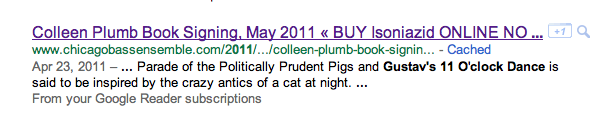
Sigh, I’ve just spent the last two hours working to remove malicious database entries from the WordPress install that runs this site. I came across a Google SERP for my site that suggested that I was a source for a pharmaceutical of some sort:

Of course, this is NOT what the Chicago Bass Ensemble provides. We are a musical group, performing chamber music for double basses. In our repertoire, we have a mix of styles from the renaissance, classical and contemporary (not so much from the late romantic period). But we’re open to anything that works well for us.

We don’t do pharmaceuticals. In removing the malicious stuff from the site, I got a lot of help from Pearsonified.com. Thank you!

I intended to write Chris Pearson a comment on his blog thanking him for sharing his knowledge, but there are so many comments already, I think I would be adding more noise than signal. So I’m thanking him here!

I always appreciate comments on THIS site, so if you happen to have noticed that we’re hacked again, please say so!

Sightreading for August 15

August 15th, 2011

Interested in what we might look at tonight? Here’s a partial list:

  • Teppo Hauto-Aho’s Two Dances
  • Patrick Neher’s Danny’s Bass Camp
  • Carolyn White’s classical/romantic collection for bass quartet, volume II
  • Joel DiBartolo’s arrangement of four Elizabethan Trios
  • Klaus Stoll’s transcription of Ortiz’ Madrigal, Canción e Recercada
  • Carolyn White’s arrangement of Dittersdorf’s Notturno
  • Klaus Trumpf’s arrangement of Bottesini’s Passione amorosa
  • Klaus Trumpf’s arrangement of Paganini’s Moses-Phantasie
  • Michael Cameron’s arrangement of Orlando’s Three Chansons
  • … the list goes on.

Needless to say, that’s a lot and we probably won’t get through it all. And in writing this, I realize that I’m leaning heavily on transcriptions and arrangements (stuff I bought at the ISB Convention), although I have several modern works that have been sent to me by friendly composers. These are on my computer as .pdf files–I will have to make time to print at least one or two of them before rushing off tonight.

What we Actually Did (an update on August 16)

As the leader of this group, I would have liked to prepare the parts and get them to people a week before a session like this. Obviously that didn’t happen. But nonetheless, John Tuck, Anton Hatwich and Beth Zaluba did me a great favor in charging ahead with this, and we had some fun as well. Here’s the list of what we actually read through and my quick notes:

  • The Teddy Bear’s Picnic: Bass Quartet by Denny Berthiaume. This is an arrangement Denny made for my friend Steven Auerbach. It’s a bit dense, being in a low-ish register, with all but the lowest voice playing pizzicato. This is a reflection of Denny’s taste as a jazz pianist (Check out the very cool group, TRIO, with my friend Mickey McPhillips on bass). It may need some rethinking, though, as the arco part tends to overwhelm the pizz. I’m hoping that Denny will expand this piece, as it could be fun to use as lighter material and/or for concerts in schools.
  • Notturno by Karl Ditters von Dittersdorf, arrangement by Carolyn White. This feels like quite a nice arrangement — Anton commented that Carolyn’s arrangements are well-balanced and transparent. Dittersdorf has a reputation a something of a lightweight–at least he doesn’t always meet with universal acclaim among bassists–but I think this arrangement will be a good addition to our repertoire for lighter or classical sets.
  • Moses-Phantasie from Nicolò Paganini arranged by Klaus Trumpf for Bassiona Amorosa. Those who know who Bassiona Amorosa is will nod understandingly when I say that we did not successfully sightread this piece in its entirety. No surprise, as it’s a virtuoso showpiece for a single bassist; this arrangement gives the solo line to all four players in turn. Meanwhile the piano accompaniment is replaced by the other members of the quartet. It will be a lot of fun to work this up sometime in the future.
  • Three Chansons by Orlando de Lassus, arranged by Michael Cameron. Music from the Renaissance really works so well for double basses. These are fun to play, with gorgeous harmony and polyphonic interaction. As there are limited or no tempo markings and dynamics and articulations are additions by the editor, Cameron encourages experimentation. I look forward to doing that as we move forward with these pieces.
  • A set of short arrangements entitled Františkoviny pro kontabasové kvarteto curated, if not arranged by Miloslav Gajdoš for the Bass Club of Kroméríž (pardon me if I’ve got those diacritical marks confused). Several of these are going to be good lightweight material, perhaps even light encores. But even for that purpose, I wish the arrangement of Eleanor Rigby developed the material a little bit, and that Moon River and Theme from Forrest Gump were either shorter or did more to develop the music. I have a hunch that these are student arrangements. Usable, in the right context.
  • Three Spanish Motets by Tomas Luis de Victoria, arrangement by Michael Cameron. See my notes about the Three Chansons above — these will definitely be demanding in terms of tuning and musicality. They’ll be easily overplayed if we get too wrapped up in our own sounds (all that orchestral section playing, you know) and overwhelm the music with bow pressure.
All in all, this was a successful reading session. I got what I needed: a sense for how these pieces sounded, so I can program the appropriately. And I reconnected with a few of my friends (Beth, in particular, seems to have a wealth of great stories about the bass scene in Chicago, having spent some of her life with Pete Zaluba), and got some material for this blog, all at the same time.
If you’re a bassist, and would like to be involved in our next reading session, whether as a player or just a listener; or if you’re a composer who would like us to read through something you’ve written, long or short, please don’t hesitate to drop me a line using the contact form here on the Chicago Bass Ensemble website.

Reading Session One!

August 14th, 2011

I’m happy to announce that I’ve arranged for several friends to get together and read through some of the music that I bought at the International Society of Bassists Convention in June of 2011.

It’s one thing to buy a bunch of music, it’s another to find out if any of it is any good. Especially in a small space like this, it’s hard to be sure. The fact that something is published is no guarantee, since it is so easy to self-publish these days.

This read-through will also help me line up some of the music that we’ll play in the coming season. I haven’t released details, but we will be playing in Arlington Heights in January, and I also hope that we’ll be on the program at next year’s Chicago Bass Festival.

Anyway, I’m looking forward to getting together with John Tuck, Beth Zaluba and Anton Hatwich on Monday (yep, tomorrow, as I’m posting this) to try some stuff out. This afternoon’s project: pick what music to read.

Jacque